
Faith partnerships are collaborative relationships between churches, ministries, and community organizations that work together to address local needs, strengthen neighborhoods, and create lasting social impact through shared resources, expertise, and volunteer action.
These partnerships matter because they transform the way faith communities engage with pressing challenges like food insecurity, homelessness, youth mentorship, and immigrant services. When a church working alone might run a small food pantry serving twenty families, a faith partnership connecting multiple congregations with a nonprofit housing organization can create a comprehensive support system touching hundreds of lives each week. The difference lies in scale, sustainability, and the ability to combine different strengths toward common goals.
If you’re wondering how your congregation can move beyond isolated programs toward meaningful collaboration, this article maps out exactly how faith partnerships function in practice. You’ll discover the core elements that make these relationships work, explore different partnership models from coalitions to sponsorships, and see real examples of how churches across Toronto and beyond are joining forces with secular nonprofits, government agencies, and interfaith groups to multiply their community impact.
Whether your church is taking its first steps toward collaboration or looking to deepen existing relationships, understanding the mechanics of faith partnerships helps you build connections rooted in trust, clarity, and mutual purpose. The stories and principles ahead will equip you to recognize partnership opportunities in your own neighborhood and give you a practical framework for turning good intentions into sustainable action that serves your community well.
What Are Faith Partnerships?
Faith partnerships are collaborative relationships where faith communities, religious organizations, and civic entities join together to serve the common good. Rather than working in isolation, these partnerships bring diverse groups, churches, synagogues, mosques, temples, non-profits, government agencies, and community organizations, into shared mission around issues that matter to neighborhoods and cities.
At their heart, faith partnerships recognize that complex community challenges require collective action. No single congregation or organization can solve homelessness, address food insecurity, or build intercultural understanding alone. When partners pool their resources, relationships, and spiritual commitments, they create capacity that extends far beyond what any could accomplish independently.
- Faith-Based Civic Partnerships
- Formal or informal collaborations between religious communities and government agencies, schools, or civic institutions to deliver services, strengthen neighborhoods, and advocate for community needs.
- Inter-Faith Collaboration
- Cooperative work between people and communities from different religious traditions, Christian, Jewish, Muslim, Hindu, Sikh, Buddhist, and others, who unite around shared values and common goals.
- Community Development
- Coordinated efforts to improve social, economic, and physical conditions in neighborhoods through housing initiatives, economic programs, education support, and infrastructure investment.
- Social Action Ministries
- Programs and initiatives through which faith communities engage in direct service, justice advocacy, and systemic change work as expressions of their spiritual commitments and values.
These partnerships take many forms. The Toronto Conference has modeled this collaborative spirit since 1925, connecting United Church congregations across the Greater Toronto Area for shared ministry, worship, and outreach. Some partnerships focus on direct service, coordinating meal programs or refugee settlement support. Others center on advocacy, bringing faith voices together to speak for affordable housing or climate action. Still others create spaces for worship and spiritual formation that cross denominational or religious boundaries, fostering understanding and shared spiritual growth.
What makes faith partnerships distinct is their grounding in values and relationships, not just transactions. Partners don’t simply coordinate logistics; they build trust across differences, learn from one another’s traditions, and discover how their unique gifts complement each other in service to the wider community.
How Faith Partnerships Work
The Foundation: Building Trust Across Traditions
Trust doesn’t arrive overnight between faith communities separated by theology, practice, or cultural tradition. It grows slowly, through repeated small interactions where partners show up, listen carefully, and honour what makes each community distinct. The foundation for partnership isn’t theological agreement, it’s genuine curiosity about how others understand service, compassion, and community flourishing.
Building this trust starts with face-to-face relationships. Leaders meet over coffee or shared meals, not to negotiate programs but simply to hear each other’s stories, challenges, and hopes. These conversations create personal connections that outlast organizational changes or disagreements down the road.
Successful partnerships respect boundaries while finding common ground. A Muslim community centre and a Christian congregation might approach prayer differently, but both share deep commitments to feeding hungry neighbours. Rather than glossing over differences or forcing uniformity, effective partnerships name what makes each tradition unique and then identify overlapping values where collaborative action makes sense.
This relational groundwork takes time, months, sometimes years, but it transforms strangers into trusted co-workers who can navigate disagreements with grace and celebrate differences as strengths rather than obstacles.

From Vision to Action: Coordinating Collective Efforts
Turning a shared vision into tangible action requires partners to move beyond agreement and into coordinated planning. This means establishing clear roles, timelines, and communication channels that keep everyone aligned as the work unfolds.
Most successful partnerships start with small, achievable projects that build confidence and demonstrate what collaboration can accomplish. A joint food drive or shared community event lets partners practice working together before tackling more complex initiatives. These early wins create momentum and reveal how each organization’s strengths complement the others.
Regular coordination meetings become the backbone of sustained partnership work. Partners share updates, adjust plans as needs change, and troubleshoot challenges together rather than in isolation. This ongoing dialogue prevents misunderstandings and ensures resources flow where they’re needed most.
Documentation matters too. Written agreements, even simple memorandums of understanding, clarify expectations around funding, volunteer coordination, and decision-making authority. When everyone knows who’s responsible for what, programs run more smoothly and partners can focus energy on serving the community rather than managing internal confusion.
The goal isn’t perfect coordination but responsive, adaptive collaboration that keeps community needs at the center.
Types of Faith Partnerships
Inter-Church Partnerships
Inter-church partnerships bring together Christians from different denominations, United, Anglican, Baptist, Presbyterian, Catholic, Pentecostal, to pursue shared ministry that individual congregations couldn’t accomplish alone. These collaborations might look like joint Sunday services during Lent, combined youth groups exploring faith across traditions, or pooled resources to run a community breakfast program.
What makes these partnerships work is focusing on common mission rather than doctrinal differences. Partners recognize they serve the same communities and share core values about compassion, justice, and spiritual formation. A United Church and a Baptist congregation might organize shared worship four times yearly while maintaining their distinct identities the rest of the time.
Toronto Conference has facilitated inter-church work since its founding in 1925, helping congregations discover natural partnership opportunities. When churches share ministry tasks like refugee sponsorship or neighbourhood outreach, they multiply their impact while building relationships that enrich everyone’s faith. These partnerships also model unity for the wider community, showing that Christians can collaborate across denominational lines without compromising their traditions.
Inter-Faith Partnerships
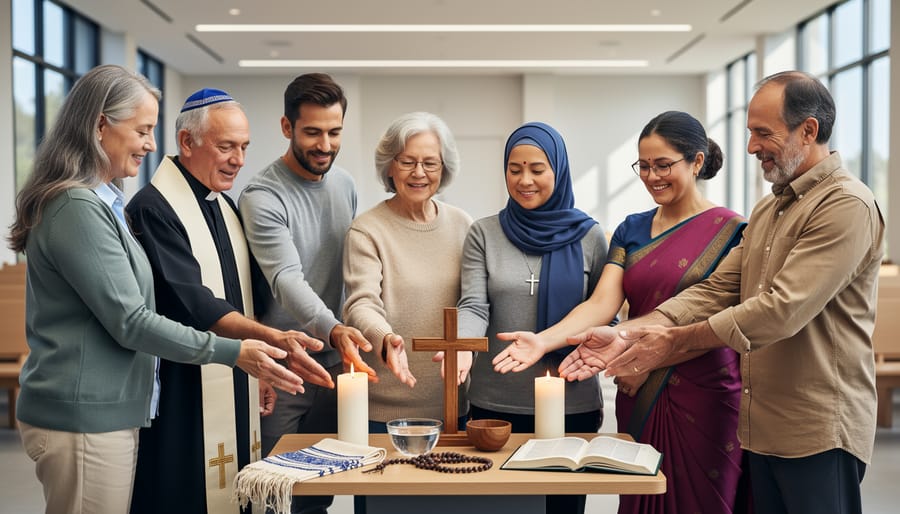
Inter-faith partnerships bring together communities from different religious traditions, Christian, Jewish, Muslim, Sikh, Hindu, Buddhist, and others, to work side-by-side on shared concerns that affect everyone. Rather than focusing on theological differences, these partnerships identify common ground: caring for refugees and newcomers, combating poverty and homelessness, promoting peace and reconciliation, or responding to community crises.
These collaborations create space for mutual learning and relationship building that goes beyond formal events. When a mosque partners with a church to run a winter clothing drive, or when a synagogue joins with a gurdwara to sponsor refugee families, participants discover shared values of compassion, hospitality, and justice that transcend doctrinal boundaries.
Inter-faith partnerships also help communities navigate cultural diversity with grace. They build trust across difference, counter prejudice and fear, and model respectful coexistence. In cities like Toronto, where religious diversity is woven into the fabric of neighborhoods, these partnerships demonstrate that faith communities can be bridges rather than barriers. The relationships formed through collaborative service create lasting bonds that strengthen the social fabric and help all communities thrive together.
Faith-Civic Partnerships
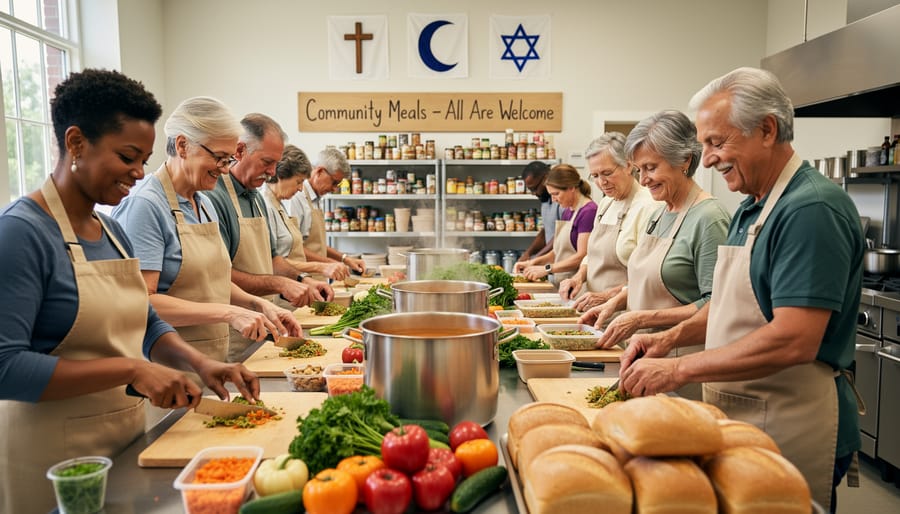
Faith-civic partnerships connect congregations with government agencies, non-profits, and community organizations to address needs that no single entity can tackle alone. These collaborations leverage the unique strengths each partner brings: faith communities offer trusted relationships, volunteers, and facilities, while civic organizations contribute expertise, funding, and systemic reach.
In Toronto, churches have partnered with municipal housing agencies to provide emergency shelter spaces during winter months, transforming fellowship halls into overnight warming centres. Other congregations work alongside public health units to deliver mental health support groups, using church buildings as accessible, stigma-free meeting spaces.
These partnerships often begin when civic agencies recognize that faith communities already serve neighbourhoods they’re trying to reach. A food bank might approach a church to host distribution days. An immigration settlement agency might partner with multiple congregations to provide English conversation circles led by volunteer tutors.
The most effective faith-civic partnerships establish clear agreements about roles, responsibilities, and boundaries, particularly around maintaining appropriate church-state separation while still collaborating for community good. They work because both partners respect what the other brings and focus on shared outcomes rather than institutional agendas.
Grassroots and Network Partnerships
Grassroots and network partnerships emerge organically from shared concerns and relationships rather than formal institutional structures. These collaborations might begin with a neighbourhood clean-up day, a community meal, or a mutual aid initiative that draws together people from different congregations and activist groups. They’re characterized by flexibility, quick response to local needs, and deep connections to specific neighbourhoods and cultural communities.
What makes these partnerships powerful is their accessibility, they don’t require committees, budgets, or organizational approval to start. A handful of committed individuals can spark meaningful change. Many successful formal partnerships began as grassroots efforts that proved their value through action. These networks often reach communities that traditional institutions struggle to engage, operating through personal relationships and shared trust rather than official channels.
Where Faith Partnerships Make a Difference
Community Development and Social Services
When congregations join forces with civic agencies and community organizations, they create powerful networks that respond to urgent local needs. Faith partnerships in Toronto have coordinated emergency shelter programs, providing faith-based help for homelessness through overnight facilities hosted in church basements and coordinated volunteer teams. Several churches now operate shared food banks that pool resources, reduce duplication, and serve more families with culturally appropriate groceries.
Immigration support offers another strong example: multi-church coalitions partner with settlement agencies to provide language tutoring, job search workshops, and welcome circles that help newcomers navigate systems and build belonging. These partnerships leverage what faith communities do best, relationship building, trust, and consistent presence, while civic partners contribute professional expertise, funding access, and program infrastructure.
The coordination multiplies impact. A single congregation might run a small meal program; ten congregations working together with a municipal housing department can launch a transitional housing initiative that serves dozens of families annually. By aligning their calendars, sharing volunteers, and advocating collectively for policy changes, faith partnerships turn compassionate intentions into sustained community development that addresses root causes, not just symptoms.
Worship and Spiritual Growth
Faith partnerships create powerful spaces where worship transcends traditional boundaries and spiritual growth deepens through encounter with different traditions. When congregations from diverse backgrounds gather for joint worship services, participants experience familiar prayers and hymns alongside new liturgies, music styles, and expressions of faith. A Korean Presbyterian congregation and a Caribbean Baptist church might co-host a Pentecost celebration that weaves together Korean hymns and gospel music, creating something richer than either could offer alone.
These shared worship experiences naturally lead to ongoing spiritual formation opportunities. Inter-church Bible studies bring together perspectives shaped by different theological traditions and cultural contexts, revealing fresh insights into scripture. Contemplative prayer groups that welcome participants from various denominations discover that silence and meditation practices connect across boundaries. Joint retreats and pilgrimages build relationships while participants learn from each other’s spiritual practices and faith journeys.
Cross-cultural learning becomes spiritual formation when partnerships move beyond tolerance to genuine curiosity and mutual enrichment, expanding how we understand and experience God’s presence in diverse communities.
Advocacy and Social Justice
Faith partnerships create powerful platforms for justice work that individual congregations or organizations couldn’t achieve alone. When diverse faith communities unite around shared concerns, affordable housing, racial equity, climate action, refugee rights, they bring moral authority, broad community reach, and sustained commitment to advocacy efforts.
These partnerships work through coordinated campaigns, unified public statements, and collective presence at community meetings and legislative hearings. A coalition of churches, mosques, and synagogues speaking together carries weight that moves decision-makers and shapes public conversation in ways a single voice cannot.
The strength lies in both numbers and diversity. Partners share research, divide advocacy tasks, and support each other through long campaigns that require persistence. Some congregations offer meeting spaces, others provide communication networks, while still others bring connections to affected communities whose stories need amplifying.
Faith partnerships also sustain advocates over time. Justice work can drain energy and test hope, but partners provide mutual encouragement, shared celebration of small victories, and renewed commitment when progress feels slow.
Key Principles for Successful Faith Partnerships
Drawing from decades of collaborative experience, including insights from United Church history since 1925 certain principles consistently emerge as foundational to faith partnerships that endure and transform communities.
Start with genuine inclusivity. Effective partnerships welcome diverse voices from the beginning, not as an afterthought. This means designing gatherings and decision-making processes that accommodate different worship styles, theological perspectives, and cultural expressions. When a partnership begins with “how do we make space for everyone at the table,” rather than “how do we get others to join our existing model,” trust forms naturally.
Practice cultural sensitivity and humility. Partners who last recognize they don’t have all the answers. They listen more than they prescribe, ask questions before making assumptions, and acknowledge power dynamics honestly. This looks like a predominantly white congregation learning from a Caribbean church’s approach to community care, or a large downtown church deferring to a neighborhood group’s understanding of local needs.
Share leadership authentically. Rotate facilitation roles, co-create agendas, and distribute resources equitably. True shared leadership means sometimes stepping back so others can step forward, recognizing that different partners bring different strengths at different moments.
Communicate clearly and often. Set expectations early about meeting frequency, decision-making processes, and how conflicts will be addressed. Regular check-ins prevent small misunderstandings from becoming partnership-ending rifts. The most resilient partnerships build in time for relationship maintenance, not just task completion.
Stay adaptable. Community needs shift, congregations change leadership, and unexpected opportunities arise. Partners committed to the relationship, not just a single project, adjust their approach as circumstances evolve while keeping core values intact.

Common Questions About Faith Partnerships
Church leaders and congregants often share similar concerns when they first consider engaging in faith partnership work. While each community’s context is unique, certain questions arise consistently across denominations, cultures, and congregation sizes. Understanding these common inquiries, and thoughtful responses drawn from decades of partnership experience, can help communities move forward with clarity and confidence.
How do we start a faith partnership?
Begin by identifying shared concerns in your community and reaching out to other congregations or organizations already working in that area. Initial coffee meetings, joint prayer gatherings, or participating in existing collaborative events can naturally lead to deeper partnership conversations.
What if theological differences create tension?
Focus partnership work on shared values and community outcomes rather than doctrinal debates. Successful partnerships respect each tradition’s distinctiveness while collaborating on practical ministry where beliefs align, serving neighbors, supporting vulnerable populations, or advocating for justice.
How do we measure partnership success?
Look beyond numbers to assess relationship quality, community impact, and sustained engagement. Effective measures include the depth of trust between partners, tangible outcomes for those served, and the partnership’s ability to adapt and continue over time.
Can small congregations participate effectively?
Absolutely. Small congregations often bring deep community connections, nimbleness, and authentic relationships that larger institutions can’t replicate. Partnerships allow smaller communities to amplify their impact by contributing their unique strengths to collective efforts.
Beyond these foundational questions, many communities wonder about maintaining their distinct identity while partnering. This concern is entirely legitimate. Strong partnerships don’t require communities to blur their traditions or compromise core convictions. Instead, they create space for each partner to bring their full identity to the table while working toward common goals. A Presbyterian congregation doesn’t stop being Presbyterian when it partners with a Baptist church on a food bank; a mosque doesn’t diminish its Muslim character when collaborating with a synagogue on refugee support.
The key is approaching partnership as “both-and” rather than “either-or”, both maintaining distinctiveness and building genuine collaboration. Regular communication, clear agreements about roles and boundaries, and honest conversation when tensions arise all help preserve each community’s integrity while strengthening collective impact. When concerns or questions emerge during partnership work, addressing them directly rather than letting them simmer builds the trust that makes sustained collaboration possible.
how it works
Faith partnerships work through intentional relationship-building that bridges differences and unites communities around shared purpose. The process starts when faith groups recognize common values, whether that’s serving vulnerable neighbors, promoting justice, or building understanding across cultures. Leaders initiate conversations, often informal at first, to explore where their missions align.
Trust develops as partners invest time learning about each other’s traditions, strengths, and limitations. This foundation allows communities to identify specific collaborative opportunities: a joint food program, shared worship space, coordinated advocacy, or interfaith dialogue series.
Partners then pool their resources, people, space, expertise, funding, and coordinate efforts so each contributes what they do best. A synagogue might offer meeting space while a church provides volunteers and a mosque brings cultural connections. Regular communication keeps everyone aligned as the work unfolds.
Successful partnerships also build in reflection, evaluating what’s working and adjusting course when needed. This rhythm of planning, action, and learning sustains collaboration beyond single projects, creating lasting relationships that strengthen the entire community fabric.
Types or components
At their heart, faith partnerships rest on several core components that allow diverse communities to work together effectively. First is shared purpose, partners must identify common values or goals that transcend individual institutional interests, whether that’s serving vulnerable neighbors or building bridges across cultural divides. Second is mutual respect, the recognition that each partner brings distinct strengths, traditions, and perspectives worthy of honor.
Resource coordination forms another essential element. Successful partnerships pool assets, facilities, volunteers, funding, expertise, in ways that multiply impact beyond what any single group could achieve alone. Communication structures matter too: regular meetings, transparent decision-making, and clear accountability keep everyone aligned and invested.
Trust-building mechanisms provide the relational foundation. These include informal gatherings, shared worship experiences, and honest conversations about differences. Finally, flexibility allows partnerships to adapt as circumstances shift, ensuring collaborations remain responsive to community needs rather than rigid in structure. Together, these components create partnerships that are both sustainable and transformative in their community impact.
Faith partnerships represent more than organizational alliances, they embody our shared commitment to building communities where everyone belongs. When churches, faith communities, and civic organizations work together, they create something greater than any single group could accomplish alone: spaces of genuine welcome, networks of practical support, and movements for lasting change.
The partnerships we’ve explored throughout this article aren’t theoretical ideals. They’re living realities in neighborhoods across Toronto and beyond, where congregations are opening their doors wider, leaders are listening across traditions, and communities are discovering their collective strength. From the food bank that serves hundreds to the worship service that brings together diverse voices, these collaborations demonstrate what becomes possible when we lead with relationship rather than institution.
You don’t need to wait for a formal initiative or perfect conditions to begin. Faith partnerships often start with a simple conversation, a shared meal, or neighbors recognizing a common concern. Whether you’re a church leader exploring inter-church collaboration, a congregant passionate about community service, or someone seeking connection across cultural boundaries, there’s a place for you in this work.
The invitation stands: What partnership might your faith community explore? What relationships could deepen your collective impact? The journey toward united, compassionate communities begins with one step, reaching across whatever divides us to discover the sacred work we can do together.